
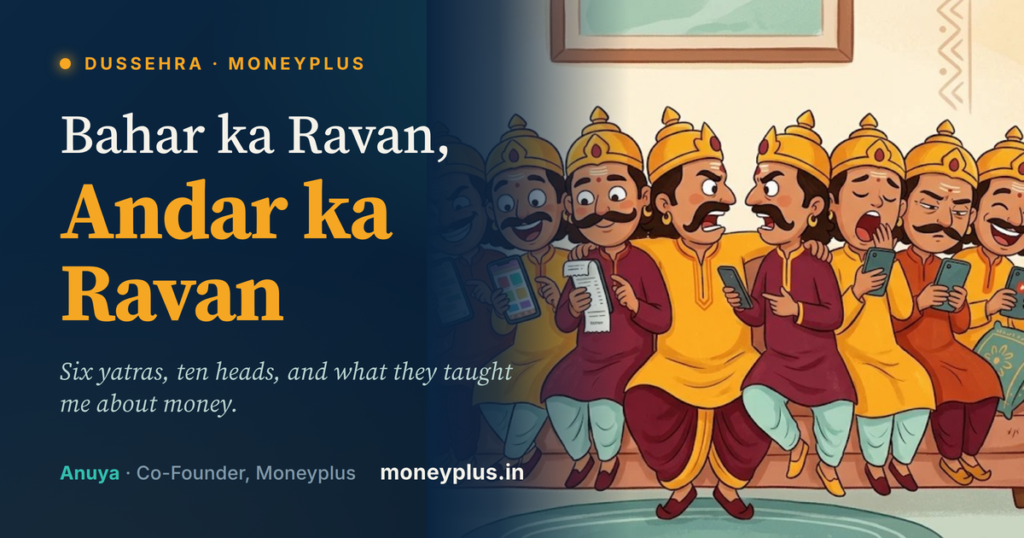
Bahar Ka Ravan, Andar Ka Ravan
Ravan gets burnt once a year. The one inside us needs daily work. What six hard yatras taught me about money, in the week of Dussehra.

Last week I wrote about my aaji’s question. “खरंच गरज आहे का?” Do you really need it?
So many of you wrote back, on the blog and on WhatsApp. One reader said the post took them back to moments from their own childhood, and thanked me for the thought. Another wrote in Marathi that the timing was right, just before Dasara and Diwali, when the sales make us buy things we do not need.
Thank you. That means a lot.
Last week was about the question at the shop counter. This week I want to go one level deeper, to the mind that asks it.
Navratri, and the Ravan outside
Navratri is on as I write this. Nine nights of Devi. Garba in the evenings, fasting in the day, a little more discipline than usual in every home.
And on Tuesday, Dussehra. Ravan’s effigy burns, the crowd cheers, good wins over evil. We go home and eat something sweet.
Next year he is back. And we burn him again.
Sochiye. If burning him once a year was enough, why does he keep coming back?
Because the Ravan in the ground is made of paper. The real one lives inside us. I learned this at some of the hardest places to reach in our country.
Where I learned it
Over the years I have been to Jagannath Puri, Rameshwaram, Dwarka, Kamakhya, Vaishno Devi, and the Shatrunjay hills at Palitana.
None of them was easy.
Long trains. Longer roads. Steps that do not seem to end. Hours in a line without knowing how much longer it will take. And rules everywhere. When to enter. What to carry. At Palitana, you must come down before sunset. No exceptions.
I went for darshan. I came back understanding my own mind better.
The noise, and then the silence
At every one of these places, the day is loud.
Chanting. Bells. People calling out the name of God. Thousands of voices asking for something, or thanking for something, all at once.
Then night comes, and everything goes quiet.
That silence is not empty. Everything is still, and things become very clear.
Somewhere in that silence I understood what these yatras were doing to me. They were teaching me to fight. Not with anyone outside. With the enemies inside me.
Ego. Desire. Fear. Anger. Greed. Attachment.
I had read about them. On those hills and in those long lines, I felt them.
That is the real Ravan. These are his heads.
Then I came back to my desk
At Moneyplus, I sit across the table from families every day. And I see the same heads. They just wear different clothes when it comes to money.
Ego says, “Mujhe sab pata hai.” It stops us from asking a simple question. It buys the car the neighbour can see, not the plan the family needs.
Desire keeps moving the finish line. A bigger flat, a better phone, one more trip. The EMI grows faster than the savings.
Fear stops the SIP the day the screen turns red. It keeps everything in FD because FD feels safe, even when prices rise faster than the FD.
Anger reacts. “Market ne paisa duba diya, ab sab nikaalna hai.” Decisions taken in anger are almost always the expensive ones.
Greed forwards the late-night WhatsApp tip to the family group. It chases last year’s best fund and the scheme that doubles money fast.
Attachment holds on. To the old policy that does nothing, kept out of habit. To the plot nobody has visited in years. To the money itself, so tightly that it never gets used for the goal it was saved for.
Each head costs money. Quietly, over years.
Now imagine Ravan himself with a portfolio. Ten heads, ten opinions. One wants to buy, one wants to sell, one is scared, one is checking the app again. Not a single head is patient. He would be the worst investor in Lanka.
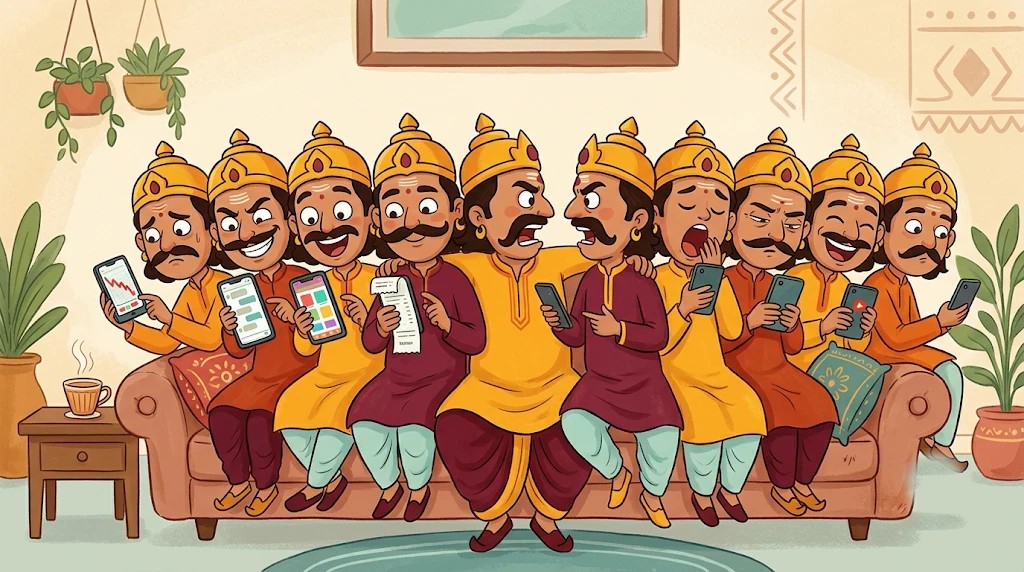
Most of us are not Ravan. But most of us have a head or two that speaks louder than the rest.
Why I am writing this now
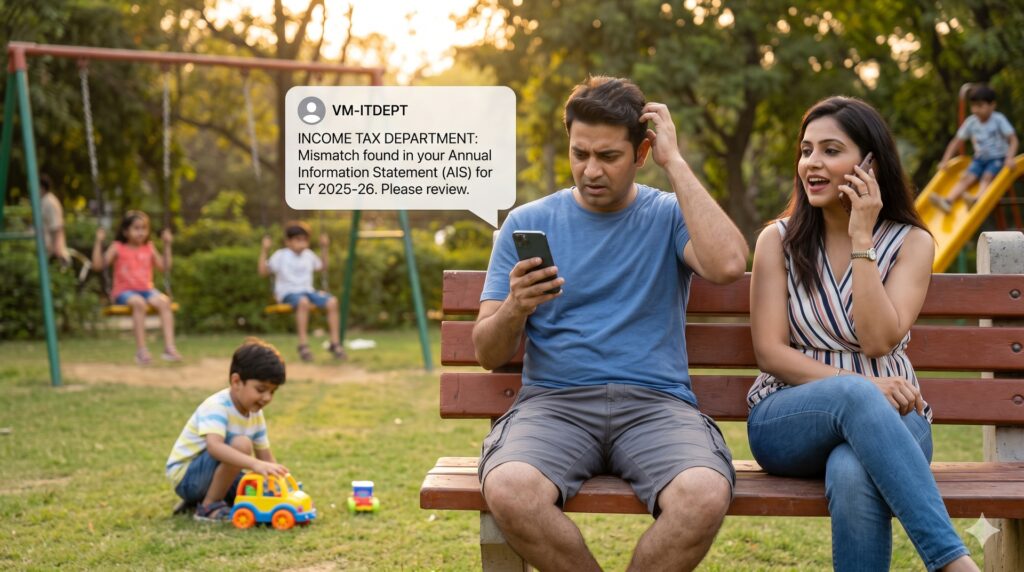
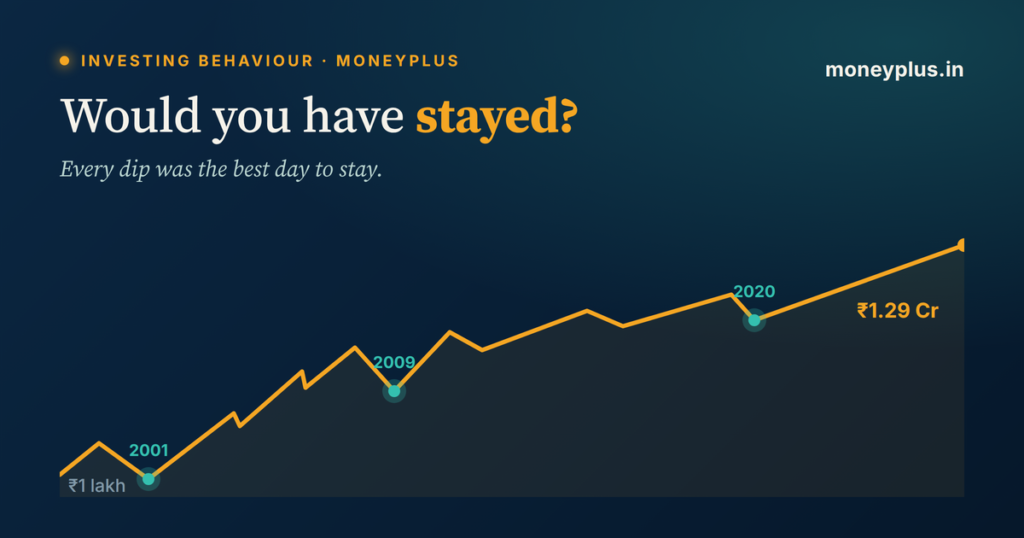
The market has been moving up and down a lot these past weeks. Green one day, red the next.
This is exactly when the heads get loud. Fear says, “SIP rok dijiye, pehle sab shaant ho jaane dijiye.” Greed says, “Sab le rahe hain, aap peeche reh jaayenge.” Neither is thinking about your goal.
Navratri is a good time to notice this. These are nine nights of discipline. If we can say no to a full plate of food for nine days, we can say no to a WhatsApp tip for one.
What the yatras taught me about money
The road is long. Accept it.
Nobody reaches Vaishno Devi in ten minutes. Wealth also takes years. Rome was not built in a day, and neither is a retirement fund.
One step at a time.
You do not climb a hill in one jump. A monthly SIP is exactly that. Small steps, every month, without skipping.
Wait in the line without panic.
In a darshan line, the person who pushes does not reach faster. He only gets tired. When the market falls, staying in the line is the hardest and most important thing.
Follow the rules.
Money needs rules too. An emergency fund. Proper insurance. Each goal kept separate. Rules feel tight, but they protect you.
Know when to come down.
At Palitana, everyone comes down before sunset. In money also, you need to know your sunset. When a goal is close, move that money to safety. Do not wait for one more high.
Find the silence.
News, tips, forwards, everybody’s opinion. The best decisions come from the quiet, not from the noise.
Financial stability is a state of mind
I used to think financial stability means a big bank balance. The yatras showed me something else.
A family with a modest income, a clear plan, and a calm mind is more stable than a rich family that panics every time the market moves.
The money comes from discipline. The discipline comes from inside.
One thing to do this Dussehra
On Tuesday, go and watch the effigy burn. Take the children. Enjoy it.
On the way home, do one small check. Which head of Ravan lives in your money?
Ask yourself honestly. “Mera SIP kis wajah se ruka tha? Dar se?” “Woh purani policy kyun chal rahi hai? Aadat se?” “Woh fund kyun kharida tha? Lalach se, ya plan se?”
Pick one head. Only one. Burn that this year.
If it is fear, keep the SIP running. If it is attachment, give that old policy a proper look this month. If it is greed, let the next tip wait a full day.
There is a Ramlila song in the film Swades. Javed Akhtar wrote one line in it that says everything I have tried to say here.
“Man se Ravan jo nikale, Ram uske man mein hai.”
Burn the effigy outside. That is the festival.
Burn one head inside. That is the yatra.
दसऱ्याच्या हार्दिक शुभेच्छा
In Maharashtra, on Dasara we give each other apta leaves as “gold” and say, “सोनं घ्या, सोन्यासारखं राहा.”
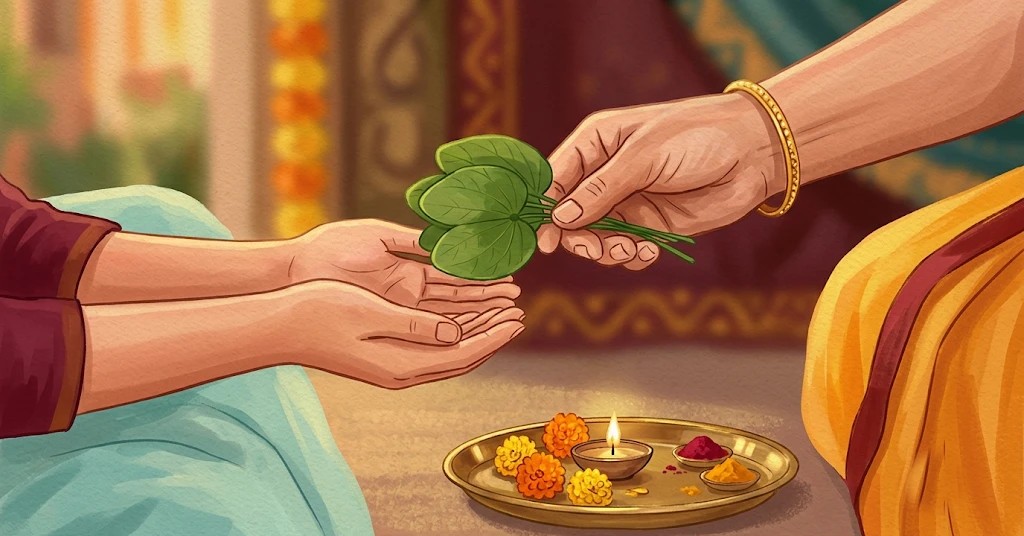
This year, along with the leaves, I wish you a calm mind with your money. That is the gold that stays.
From all of us at Moneyplus, a very happy Dussehra to you and your family.
Anuya
The illustrations in this post are AI-generated. Song line from “Pal Pal Hai Bhaari”, Swades (2004). Lyrics: Javed Akhtar. Music: A.R. Rahman.
Moneyplus is an AMFI-registered mutual fund distributor — ARN-137949. What you read here is general information written from experience, not a recommendation to buy or sell any scheme, and it does not take your personal situation into account. As a distributor, Moneyplus earns commission on the schemes it transacts for its clients. Mutual fund investments are subject to market risks; read all scheme related documents carefully. Past performance does not guarantee future returns.
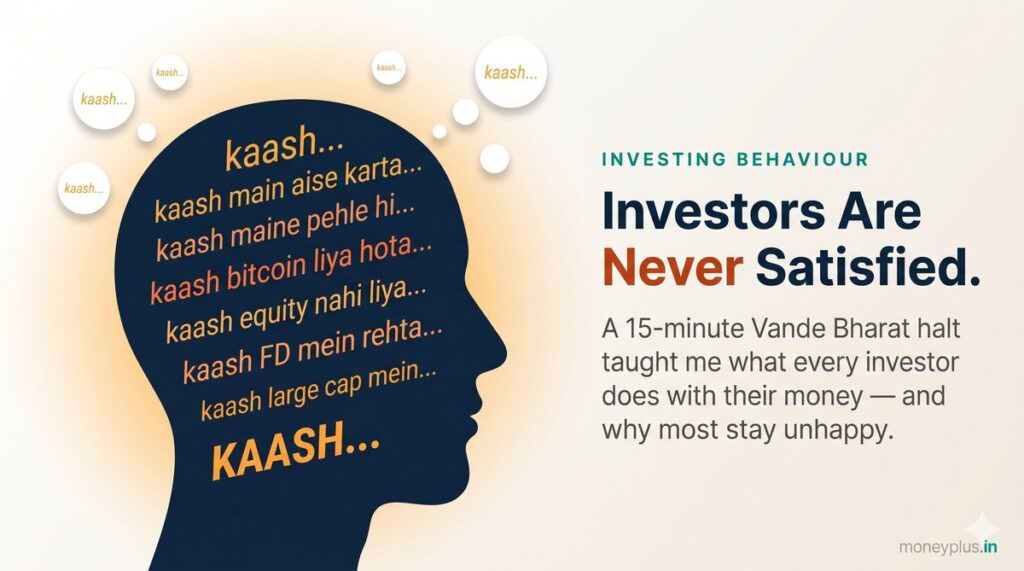

A powerful reminder that the biggest battles are often within us. In investing and in life, discipline and self-awareness matter more than reacting to every situation. Truly insightful!
अभिनंदन ! आपल्या प्रत्येकाच्या आतील रावणाबद्दल अतिशय सुरेख पद्धतीने वर्णन केलेले आहे.मी आत्ताच आर्ट ऑफ लिविंग चा ॲडव्हान्स कोर्स केला. त्यामध्ये देखील याबाबत अतिशय शास्त्रोक्त पद्धतीने मेडिटेशन व ध्यानधारणा करून मनावर नियंत्रण व ताबा मिळवण्याबाबत मार्गदर्शन आहे. असे अनेक उपाय भारतामध्ये उपलब्ध आहेत. त्याचा देखील लाभ घेऊन आपल्या मनावर नियंत्रण संयम ठेवून आपण सुंदर जीवन जगू शकतो. धन्यवाद !