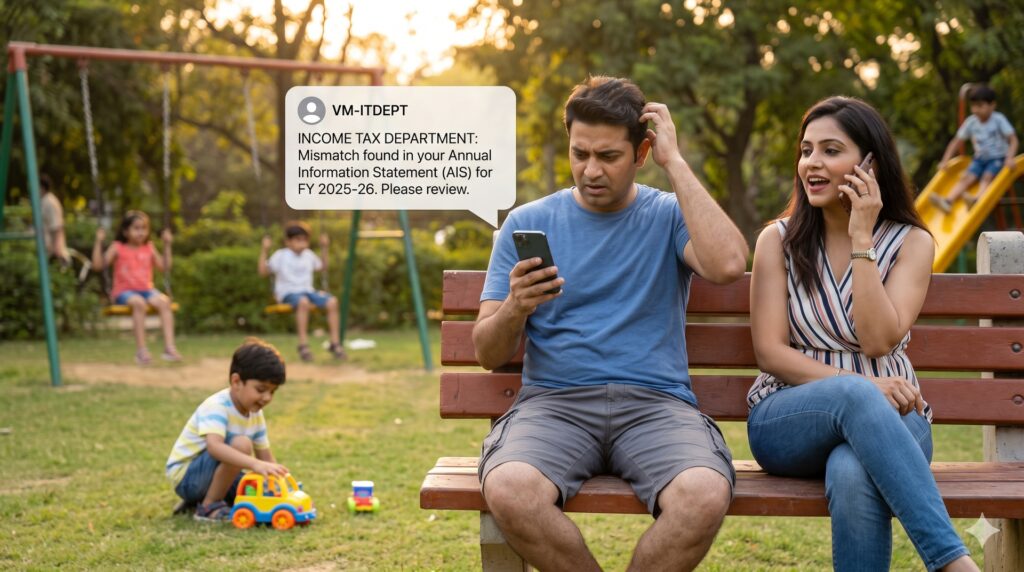
The Income-Tax Department Already Has a File on You
You don’t get “caught” anymore. By the time you file your return, the department has already watched the whole year — here are the ten moments it was taking notes.

Sandeep had never cheated on a tax return in his life.
So when the message came on a Tuesday afternoon — “Information mismatch in your Annual Information Statement” — his first feeling was not guilt. It was confusion.
He had not done anything wrong. And he was right. He hadn’t.
That whole year, Sandeep had really done only three things. He sold an old flat. He put the money into a fixed deposit. And he took the family to Thailand for ten days.
An ordinary, honest year.
What he did not know was this: each of those three steps had quietly told the income-tax department about itself — long before he ever sat down to file.
The system just never forgets.
Nobody is watching you. Everything is being recorded.
Here is the part most honest people get wrong.
They picture a tax officer sitting in some office, choosing whom to check. So they think, “I am a small man. Who will bother looking at me?”
That is not how it works anymore.
You are not being watched by a person. You are being recorded by the system — on its own, without anyone deciding to.
Your bank, the property registrar, your mutual fund company, your credit-card company — none of them ask your permission. The law tells them to report certain transactions by themselves. That report has a name: the SFT, the Statement of Financial Transactions.
By the time the year ends, all of it is gathered in one place — your AIS, the Annual Information Statement. And you can open it yourself, any time, on the income-tax website.
Ten kinds of transactions are the flash going off.
The ten moments the flash goes off
You don’t need to learn these by heart. You only need to know they exist — so that nothing surprises you later.
| What you do | The line it crosses |
|---|---|
| Cash into a savings account (in one year) | ₹10 lakh |
| Cash into a current account (in one year) | ₹50 lakh |
| Credit-card bill paid in cash (in one year) | ₹1 lakh |
| Total credit-card spend, paid any way | ₹10 lakh |
| Buying or selling property | ₹30 lakh |
| Fixed deposits made in a year | ₹10 lakh |
| A foreign trip / buying foreign currency | ₹10 lakh |
| Shares or mutual funds bought | ₹10 lakh |
| A gift taken in cash, without paper | ₹50,000 |
| Cash taken from one person in one day | ₹2 lakh |
Cross any one of these, and a small note about you reaches the department. Read them together, and they fall into three plain groups.
Cash leaves the loudest footprint
People think cash is quiet. It is the opposite. Five of the ten lines are about cash — the savings account, the current account, the card bill paid in cash, the cash gift, and the ₹2 lakh taken from one person in a single day. They are all there for one reason: cash is exactly what the department watches hardest.
One that bites a little harder
Taking ₹2 lakh or more in cash from one person in a single day is not just reported — it can carry a penalty equal to the amount itself. A ₹2 lakh cash payment can quietly cost you another ₹2 lakh.
Big steps announce themselves
A house, a large FD, a big mutual-fund purchase, a family holiday abroad — these are good things. Happy things. But each one is large enough that the bank or the registrar reports it without anyone asking.
Your card keeps a diary
Spend ₹10 lakh on a credit card in a year, paid in any way, and that total is shared too. Not because spending is wrong — only because the number is big.
There is one small habit, though, that quietly drags honest people into trouble here — lending your card to a friend. It feels harmless. Your friend wants a ₹60,000 phone on Amazon, your SBI card has the cashback that month, so you swipe it for him and he hands you the cash later. Everyone is happy.
But the card does not know it was his phone. To the system, you spent that money. Do this a few times in a year — a phone here, a flight there, a bit of somebody’s shopping — and your card total can quietly cross ₹10 lakh, sitting well above what your own income would explain.
Now the department asks a fair question: how did someone earning this much spend that much? You know the real answer — most of it was never yours. But the cash your friends handed back left no trail, so there is nothing to show. And “it was my friend’s purchase” is very hard to prove after the fact.
And here is what even careful people forget: your dividends, your bank interest, your profit on shares — these are reported down to the last rupee. No limit at all. The small things are in the photograph too.
Crossing a line is not a crime
Read that table once more, slowly. Notice something.
Almost everything on it is completely legal.
Buying a home. Keeping an FD. Starting an SIP. Taking your parents on a trip. None of this is wrong. None of it can get you into trouble on its own.
The only people who get hurt are the ones whose return does not match the photograph. That is the whole game. Match the picture, and a notice is just paperwork. Don’t match it, and a perfectly honest year slowly starts to look like a hidden one.
Sandeep’s mistake was not the flat, or the FD, or the holiday. His mistake was filing his return without ever looking at his own photograph first.
A quiet word, for those who still deal in cash
Some of you reading this — a doctor with a busy clinic, a shopkeeper who has always run on cash — may be thinking, “This is not really about me. I manage.”
For a long time, that was true.
But look at the direction things are moving. Every year, one more counter goes digital, one more limit comes down, one more report files itself on its own. Cash is not being banned. It is slowly losing its place.
And here is the part that matters more than any limit: money that is not on the books cannot work for you. It cannot be invested without raising a question. You cannot borrow against it. You cannot show it the day you sell your clinic or your shop. You cannot hand it cleanly to your children. Money that is on the books can do all four.
You do not have to change everything in one day. Just begin — slowly, on your own terms — while it is still your choice and not a notice. People who move early always move more comfortably than the ones who wait to be moved.
Before you file, look at your own photograph
This is the simplest habit there is, and almost nobody follows it.
Before you file your return, open your AIS. It sits on the income-tax website, right next to Form 26AS and the TIS. It takes a few minutes.
Read it like a stranger reading about you. Does every big number make sense? Does anything look larger than it should? If something surprises you, sort it out before you file — not after the department asks.
A mismatch found after you file becomes a notice. The very same information, checked before you file, is just a tick on a list.
And a long memory worries just one kind of person — the one with something to forget.
Want a calmer relationship with your own money?
The Moneyplus team can help you read your AIS, line it up with your return, and plan the big moves — a property sale, a large FD, a foreign trip — cleanly and on paper before they happen.
Moneyplus Editorial
This blog is for general awareness only. Sandeep is a composite illustration, not a real client. The reporting limits mentioned reflect SFT rules current as of June 2026 and are subject to change. This is not a substitute for help with your own situation — for anything specific, please check with your CA or the Moneyplus team.