There’s a Real Estate Format Most People Haven’t Tried Yet
Buying property for capital growth is one thing. Buying property for monthly cash flow is another.

Mr. Patel’s property file
Mr. Patel from Nashik is a successful businessman. Last week, over chai, he opened his property file and showed us:
- One plot in Sinnar — bought in 2014. “It was an upcoming area.”
- A 2-acre farmland near Igatpuri — “One day I will build a weekend home.”
- A 2BHK flat in Pune — “Empty for 6 months. The brokers are tired.”
Total investment over 12 years: about ₹3.2 crore.
Total monthly income from all of this: ₹0.
that is his only return plan.
Mr. Patel is not wrong
Real estate is a good asset. Wealth is built in real estate. This is true. We have seen it for 20 years.
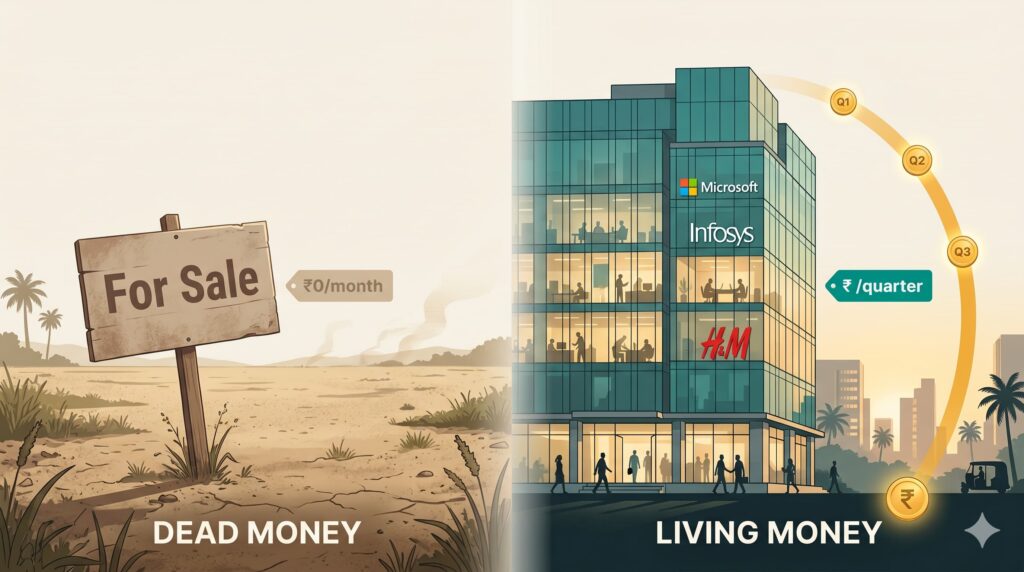
But Mr. Patel bought the kind of real estate that gives money only on sale. It does not put money in his account every month.
The kind that does put money in your account every month — IT parks in Bangalore, office towers in BKC Mumbai, malls in Hyderabad, campuses in Hinjewadi Pune — was never available to him. Ticket size was ₹50 crore or more. Tenants were companies like Microsoft, Infosys, Zara, H&M.
That was the story until a few years ago.
What is a REIT, simply put
REIT means Real Estate Investment Trust. In simple words:
There is a strict rule from SEBI: a REIT must give 90% of its cash income to unit-holders every year. By law. This is what makes the “regular cash flow” promise a contract, not just marketing.
So where does the cash actually come from?
The REIT owns the buildings. Tenants like Microsoft and Infosys pay it monthly rent. From that rent, the REIT pays its own expenses — property tax, insurance, maintenance, interest on loans. What is left over is called the Net Distributable Cash Flow (NDCF). That 90% SEBI rule? It applies to exactly this NDCF.
Today, India has 5 listed REITs
| REIT | What it owns | Yield (approx.) |
|---|---|---|
| Embassy Office Parks | IT campuses led by Bangalore | ~5.5% |
| Mindspace Business Parks | Offices in Hyderabad, Pune, Mumbai | ~4.9% |
| Brookfield India REIT | Offices in NCR, Mumbai, Kolkata | ~5.9% |
| Knowledge Realty Trust | IT / office (recently listed) | New — TBD |
| Nexus Select Trust | Shopping malls across India | ~5.4% |
A 5.5% yield per year means money comes into your bank account every quarter, automatically (the units sit in your demat account; the cash payout comes to your bank). On top of that, if the property value rises, you also get capital appreciation.
And selling? It is one click on the stock exchange.
A REIT takes 3 minutes.
The tax part — a quiet surprise
The quarterly cash you receive from a REIT is not one single number. It is made of three small pieces — and most of it is taxed exactly like FD interest, at your normal slab.
The pleasant surprise is the fourth piece, called “return of capital” — this part is tax-free.
Why? Because it is not really income. It is your own money coming back to you, like getting change after paying a bill. The Income Tax department does not count it as income.
The small catch
The tax-free piece quietly reduces your effective purchase price. So when you eventually sell the REIT, your gain is a little larger and the tax on sale is a little more. It is a deferral, not a free pass — but deferral itself is valuable. Paying tax later is almost always cheaper than paying it today.
And when you do sell after holding for more than 12 months:
- Long-term capital gains tax is only 12.5%
- The first ₹1.25 lakh of LTCG per year is fully exempt (this exemption is shared across your equity and REIT gains together)
Compare this with Mr. Patel’s Sinnar plot — stamp duty, brokerage, registration, capital gains tax. Plus the headache of finding a buyer.
Why this matters for you
In your own portfolio, you probably also have:
- A plot that has been sitting idle for 8 years
- A farmhouse you visit twice a year
- A flat that is empty or rented at a low yield
This real estate is built with your hard work. Please do not see it as wrong. Just see this — there is another category of real estate that also exists. One that:
- Puts money in your bank account every quarter
- Has Microsoft, Infosys, or H&M as the tenant
- Does not need a broker to be sold
- Has a tax structure that saves you more money, not less
- Has a ticket size of ₹500, not ₹5 crore
For people who love real estate, this is an extra option — not a replacement. A way to diversify that respects your existing love for real estate and gives you a working version of it.
What you can do today
Many of our clients run a Moneyplus Stock SIP — a fixed amount goes into selected stocks every month. It is a discipline. Not index investing — chosen stocks.
Treat a REIT the same way — like one more stock. A simple message to your RM (Relationship Manager) is enough — something like: “Please add one REIT to my monthly Stock SIP. ₹2,000–5,000 per month is fine.”
After 12 months, you will have built up — in small pieces — a position in commercial real estate. The quarterly cash flow will start coming in. The same thing that Mr. Patel’s Sinnar plot did not deliver in 12 years, your REIT position will start delivering in 12 months.
The bottom line
Want to add a REIT to your monthly Stock SIP?
Speak to your Moneyplus RM — we will walk you through which REIT fits your portfolio and set up a small monthly investment alongside your existing Stock SIP.