Would You Have Stayed?
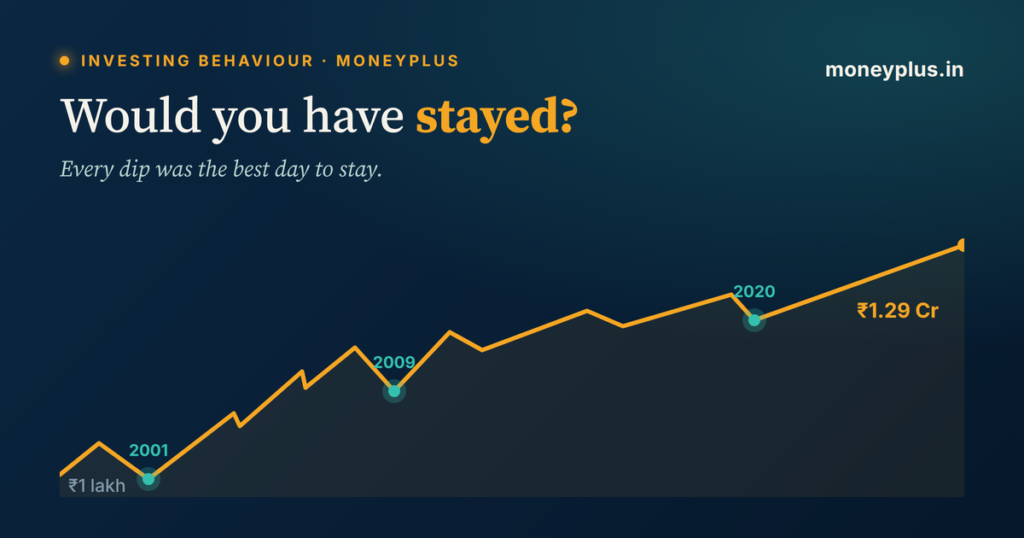
A real fund turned ₹1 lakh into ₹1.29 crore over 27 years. Walk through those years honestly, and you’ll understand why almost nobody collected it.

Here is a true story. Every number in it is real, taken from the published NAV history of one equity fund — a fund whose name you would instantly recognise, which is exactly why we’re not naming it. This story is not about one fund. We’ve seen it play out, with small variations, across every good fund of the last two decades.
In July 1999, ₹1 lakh went into this fund.
Today, that ₹1 lakh is ₹1.29 crore. Multiplied 129 times.
You’ve seen headlines like this before. You’ll see one this week — some fund, some period, some jaw-dropping multiple. And every time, the same thought: lucky people, whoever stayed invested.
Here’s what we want to do today. We want to take you through those 27 years — not as a chart, but as the person holding the money. At each stop, we’ll ask you one question, and we want you to answer it honestly.
Stop 1 — September 2001. Your ₹1 lakh is ₹91,000.
Two full years have passed. You haven’t earned a rupee. You’ve lost money. Your fixed-deposit friends are ahead of you, and they know it.
There is no way to sugarcoat this: twenty-six months into the greatest investment of your life, you are below your starting point.
Would you have stayed?
Whoever left here walked away with ₹91,000 — and left ₹1.29 crore behind.
Stop 2 — April 2004. Your money has tripled.
₹3.64 lakh now. And this is a more dangerous stop than the last one, because this time the voice in your head isn’t fear. It’s wisdom: “It has tripled. Don’t be greedy. Book the profit.”
We meet this investor more often than the panicked one. He doesn’t leave because he’s scared. He leaves because he’s sensible.
He took home 3.6 times his money — and left the remaining 35 times on the table.
Stop 3 — March 2009. ₹14.68 lakh has become ₹5.88 lakh.
By January 2008 your money had grown to ₹14.68 lakh. Then the world broke. Fourteen months later you’re holding ₹5.88 lakh — ₹8.8 lakh has evaporated, and every channel is explaining why the global financial system is finished.
Would you have stayed? Really?
Stop 4 — November 2010. You survived. You recovered. Everything.
₹20 lakh now. You rode the worst crash of a generation and came out ahead. And now a quieter, more reasonable voice speaks: “God gave you a second chance. Don’t test him twice.”
This exit doesn’t come from fear. It comes from scar tissue. And on that day, it sounds like the most mature decision of your life.
Stop 5 — March 2020. ₹45 lakh has become ₹26 lakh.
₹19 lakh gone in nine months. The country is locked down. The streets are empty.
Notice something: this crash was smaller than 2008 — 42% against 60%. But it took more than double the money, because by now your corpus was big. That is the part nobody warns you about.
precisely because your plan is working.
Pass the ₹19 lakh test, and somewhere ahead a ₹50 lakh test is waiting.
And this stop you cannot answer hypothetically — you were there. March 2020 actually happened to you. Think honestly: what did you do that month? Did your SIP continue? Did you pause it? Did you look for the redeem button?
Stop 6 — December 2020. Fully recovered, and it feels fake.
₹45 lakh again, in nine months flat — while the economy is still shut and every expert is calling the rally a bubble. Leaving now doesn’t just feel safe. It feels clever.
Here is what the clever exit cost: in the five and a half years after December 2020, this fund earned more than it had earned in its entire first twenty-one years. The person who left at the recovery missed the single biggest stretch of the whole journey.
Now the part that still gives us goosebumps
Across these 27 years, the fund’s three worst days — the exact dates the money hit rock bottom — were:
17 September 2001. 9 March 2009. 23 March 2020.
And the three best days — the exact dates the three biggest recoveries began:
17 September 2001. 9 March 2009. 23 March 2020.
So who actually collected the ₹1.29 crore?
In our experience — and we say this after twenty years of sitting across the table from investors — the person who completes this journey is almost never the smartest person in the room.
It’s the person who treated these units the way Indian families treat gold.
Think about the gold sitting in your locker. Do you check its price every morning? Did you sell it in 2008? In 2020? Of course not. Gold gets bought, put away, and left alone for decades. Nobody panics out of gold, and nobody “books profit” on it either.
That one habit — applied to a good equity fund — is the entire difference between ₹91,000 and ₹1.29 crore.
The investor’s only job was to not interrupt.
One thing to do today
The next fall is not a possibility — it’s a schedule.
This fund fell 20% or more seven times in 27 years — roughly once every four years.
And the next one will take more rupees from you than any fall before it, because your corpus is bigger now.
So take five minutes today, while the market is calm and your mind is quiet, and write one line on paper:
Fill in the blank now. Whether the SIP continues. Whether anything gets redeemed. Whether you’ll add more if you can.
Because on the day it happens — and it will — that decision cannot be made fresh. The decision written in peacetime is the only one that survives the war.
The bottom line
The fund completed the journey. 129 times over, it kept its side of the deal.
The question was never whether the fund would arrive.
The question was always the one we’ve been asking you since 1999:
Not sure you’d have stayed? That’s exactly what we’re for.
The written plan, the calm voice on the bad day, the hand that stops the redeem button — sit with us once and let’s build your version of it.
Moneyplus Editorial
This blog is for educational purposes only. The journey shown is the actual published NAV history of one real equity fund, left unnamed because the pattern belongs to every good fund, not just one. All values are as of July 2026 and are indicative. Past performance is not a guarantee of future returns. Mutual fund investments are subject to market risks; please read all scheme-related documents carefully. Speak to the Moneyplus team before making any investment decision.