
How a mutual fund distributor from Jalgaon and Nashik — armed with 20 years of broken workflows and an AI coding assistant — ended up building an enterprise-grade CRM.
I want to tell you a story. It’s not a startup story. It’s not a tech story. It’s the story of a guy who spent twenty years searching for a software that understood his business — and eventually realized that the only person who could build it was him.
If you’re a financial distributor reading this, you’ll probably see your own reflection somewhere in here. If you’re from the tech world, you might find it hard to believe. And if you’re one of our clients — well, this one’s really for you.
Chapter 1: The Reluctant Entrepreneur
I started Moneyplus in 2006. I was 21. My wife Anuya — a chartered accountant — and I didn’t choose this business. Certain situations in the family meant we needed to start something that didn’t require capital. Financial distribution was that something.
I was an MBA. She was a CA. Neither of us had dreamed of selling mutual funds for a living. But life doesn’t always ask for your preferences. It hands you a situation and watches what you do with it.
What I did was fall in love with it — slowly, reluctantly, and then completely.
We started in Jalgaon — a small city in Maharashtra that most people outside the state haven’t heard of. Four years ago, we expanded our base to Nashik, and today Moneyplus operates across both cities with a growing team and a client base that spans the country.
Chapter 2: The Lamp That Never Went Out
Here’s the thing about me: I was always a tech guy trapped in a finance career. I couldn’t code. I didn’t study computer science. But I had this quiet, persistent itch — this need to use technology to make things better, faster, sharper.
In 2006-07, when most distributors were still distributing pamphlets, I was figuring out how to send bulk SMS to clients. It sounds laughably basic now, but back then, it was a quiet superpower. While others were cold-calling from a diary, I was reaching hundreds of people at once.
That itch never went away. Every year, I’d find some new tool, some new platform, some small automation that gave us an edge. I never knew that all these small experiments — each one seemingly insignificant on its own — were quietly building the vocabulary I’d need twenty years later.
Chapter 3: From Paper to Pixels
Let me take you back to what mutual fund distribution looked like in the early days. Every transaction was physical. Paper forms. Client signatures. Courier to the AMC. Then pray that it gets processed before the cut-off time.
The first real revolution came when CAMS launched a platform called Finnet, where we could punch transactions online. The paper was still there, but the time-stamping was digital. And people noticed. Our speed and accuracy stood out — the kind of edge you get when you’re the first one in the room to adopt a new tool.
Then, in 2013, something happened that changed everything for us. When the National Stock Exchange rolled out its mutual fund platform, they chose Moneyplus as one of their pilot partners. A small firm from Jalgaon, selected to test a national platform. That day, we started our complete migration from physical to digital.
By 2015, we were fully online. Not a single piece of paperwork. We were onboarding clients across the country — sometimes across the world — while most of our competitors were still collecting wet signatures.
Chapter 4: The Excel Era
My first “system” was Excel. Not a diary. Not memory. Excel.
I am genuinely proud to say that we have every single record from those early days. Every client. Every transaction. Every communication. Documented. From 2011 onwards, every document has been scanned and stored digitally — we now have over 70,000 documents in our repository.
Every report we send to a client? Catalogued. Every statement? Archived with a reference. So if a client calls and says, “That statement you sent me last month…” — we’re on the same page. Literally.
Excel served us well. It was the Swiss Army knife of financial distribution — versatile, familiar, and always there when you needed it. But it had a ceiling. And by year seven or eight, as the team grew, we hit it. Hard.
Chapter 5: The Software Safari
This is the part of the story where things get painful. And a little funny, in hindsight.
Between 2009 and 2024, I went on what I can only call a software safari. I tried everything. Trello for task management. Asana for workflows. Airtable for databases. ClickUp for project management. Notion for documentation. Google Sheets for collaboration. Retable for collaboration. Google Talk in the early days. Yahoo Messenger. (Yes, really. We even used it for client communication.)
For mutual fund portfolio management, we eventually invested in InvestWell around 2013-14. That was a genuine turning point — their software handled portfolio valuation, capital gains, and client statements far better than our Excel sheets ever could. I must say, InvestWell was one of the most important steps in our growth story. They’ve put twenty years of dedication into building that platform, and it shows. It freed up our team for higher-value work. We continue to use them today, and they remain an integral part of our stack.
But here’s what nobody tells you about running a financial distribution business: a single client can have exposure across mutual funds, insurance, demat accounts, fixed deposits, loans, and products that don’t even have a category yet. And none of your software talks to each other.
That fragmentation was the silent killer. Not because the individual tools were bad — many of them were genuinely good at what they did. But my business doesn’t operate in silos. My clients don’t think in verticals. So why should my software?
Chapter 6: The Paid Platform on Open-Source Rails
A few years back, I discovered a platform built on top of ERPNext — the well-known open-source ERP framework. The platform itself was a paid product with a polished interface on top. It looked like the answer to everything. I grabbed a lifetime deal for around $900 and thought — this is it. The endgame. Finally.
It wasn’t. Not even close.
The learning curve was a cliff, not a curve. I spent nearly ₹3-4 lakhs on vendor development trying to customize it to our needs. And here’s what I learned — the hard, expensive way:
They’re from tech backgrounds. They don’t understand financial distribution. They don’t know what a UCC code is, or why a policy endorsement is different from a renewal, or why a client’s PAN number needs to be linked across six different systems.
And your meter is running. Every hour. ₹1,000 here. ₹1,000 there. Explaining, re-explaining, getting back something that’s close but not quite right — and then explaining again.
I explored Zoho next. Powerful, yes. Pocket-friendly for what I needed? Not remotely. I spoke to tech friends about custom-building something. Every conversation ended the same way — hours spent on planning and designing, chai consumed in industrial quantities, and zero outcomes.
I was burning money and time on a problem that nobody else seemed to understand. Because, honestly, who else has this problem? Most financial distributors are happy with one or two tools. I wanted an ecosystem.
Chapter 7: Getting Closer
Two things happened that changed my trajectory, even though I didn’t realize it at the time.
First, I met Fagun Shah, who introduced me to Pabbly Connect — a workflow automation platform. That was my first real introduction to the world of APIs and integrations. Suddenly, I could make two systems talk to each other without writing a single line of code. I automated workflows between our tools. I connected things that were never designed to be connected. The feeling was electric — like discovering a secret passage in a building you’ve walked through a thousand times.
Then came Kris, who helped me set up robotic automation flows — taking the concept further, making our operations tighter.
Something was shifting in my head. I was starting to think in systems, not in software. I was starting to see connections, not features. Every tool I used, every workaround I built, every frustration I swallowed — it was all training. I just didn’t know for what yet.
Chapter 8: The 90% Solution
Eventually, we onboarded on Sanchay CRM — a platform built specifically for the financial distribution ecosystem. And I have to give credit where it’s due: the Sanchay team understood our business in a way that no generic CRM ever could. They had lived in the trenches of financial distribution, and it showed in the product.
For the first time, our verticals were talking to each other. Insurance, mutual funds, client management — all in one place. The team was supportive, they were responsive, and for the first time in nearly two decades, it genuinely felt like we’d found our answer.
I want to be clear: Sanchay is a genuinely good product, and for most financial distribution firms, it would be more than enough.
But here’s the truth about vendor-built software — even the best ones: they solve 90% of the problem. And for most businesses, that 90% is a gift.
But I’m not most businesses. And that remaining 10% was exactly where my competitive advantage lived.
I’m a sub-broker with SMC Global. No CRM vendor is going to build a connector with SMC, because there are thousands of brokers across India and every distributor works with a different one. We use InvestWell for mutual fund management — but there are hundreds of MF software providers, and no single CRM can integrate with all of them.
These aren’t bugs. They’re structural limitations of any market-based product. The vendor isn’t at fault. The model itself has a ceiling.
And I refused to live under that ceiling.
Chapter 9: “Is This for Real?”
I owe this chapter to Neeraj Agrawal, the founder of Pabbly.
Here’s the irony — and it’s the kind that makes you believe in good people. Neeraj runs an automation platform that I was heavily using. Pabbly Chatflow for WhatsApp. Pabbly Connect for workflows. His tools were a significant part of our daily operations.
And it was Neeraj who told me about AI-assisted coding environments — specifically Claude Code. He essentially pointed me toward a tool that would, eventually, eliminate my need for his own platform.
Let that sink in. The founder of a product I was paying for told me about a technology that would make his product unnecessary for me. That kind of humility and generosity is rare in any industry. I want to publicly acknowledge it. Thank you, Neeraj. You lit a fuse you probably didn’t realize you were lighting.
I started with Claude’s desktop app. No specs on paper. No wireframes. No design documents. Just conversations. I would describe a workflow — the way I actually do business, in my language, with my context — and the AI would translate it into working software.
My first small project worked. And I remember staring at my screen thinking:
My first ten days of conversation, and I had a complete blueprint. Now, that might sound unbelievable — a blueprint in ten days? But here’s what I want you to understand: it wasn’t ten days of work. It was twenty years of context, compressed into ten days of conversation.
Every frustration, every broken workflow, every limitation I’d hit with every software I’d ever used — all of that was now fuel. I knew exactly what I wanted because I’d spent two decades learning what I didn’t want. The vocabulary was already there. The understanding was already there. The AI didn’t build Aventryx. It translated what was already in my head.
Chapter 10: Aventryx Is Born
What emerged over the next thirty days is something I still find hard to describe without getting emotional.
Aventryx — our own operating system. Not a CRM. Not a tool. An operating system for Moneyplus.
Let me give you the numbers, because I think the numbers tell a story that words can’t:
436 API routes
119 frontend pages
34+ modules — every single one complete
19 automated cron jobs running daily
7,500+ clients migrated from legacy systems
What does it actually do? Everything.
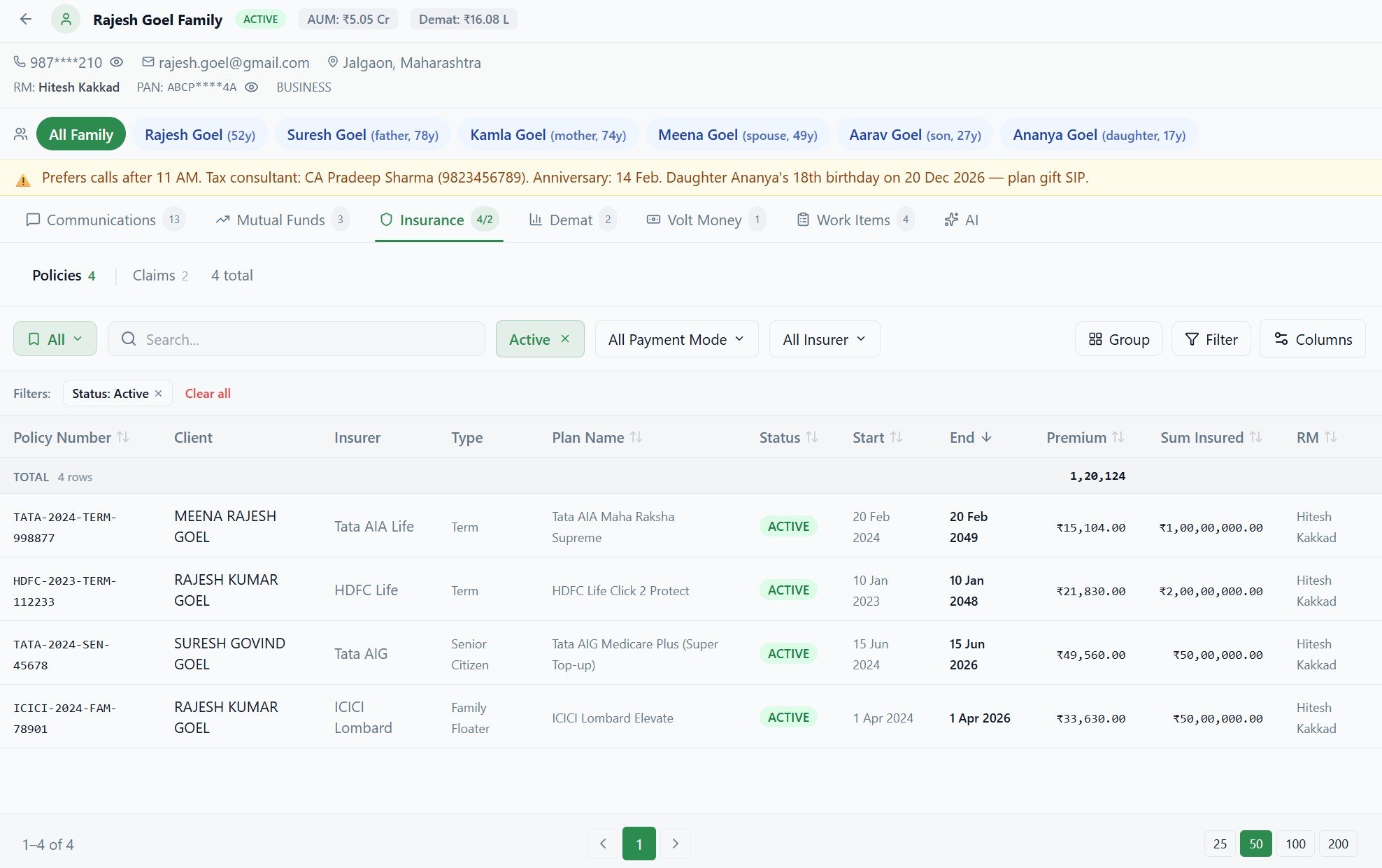
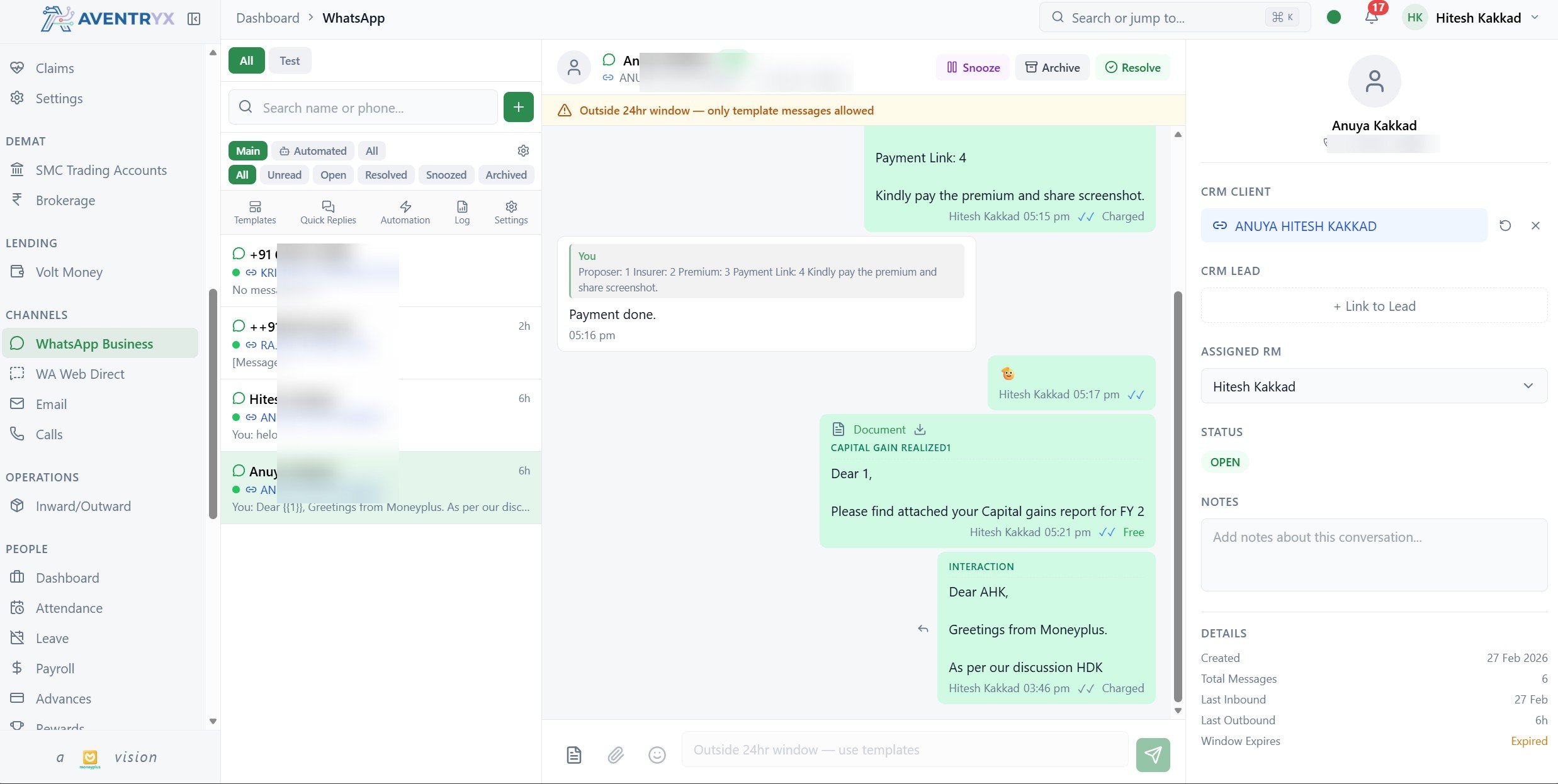
Client management with complete family grouping, document storage, and interaction history. Insurance — from pipeline to quotes to policies to claims to brokerage reconciliation. Mutual funds — integrated with InvestWell for real-time portfolio data. Demat accounts — connected directly to our broker for live holdings and trade data. WhatsApp — a full inbox, campaign engine, and automation system built from scratch. HR module — attendance, leave, payroll, advances for our team in Jalgaon and Nashik. Workflow automation — triggers that fire across email, Telegram, and WhatsApp. AI-powered document analysis — with multi-pass processing and privacy-first masked data handling.
And the piece I’m most proud of: the Client Workspace.
Chapter 11: The Mahesh Sir Test
Here’s how I measure whether a feature works: the Mahesh sir test.
Mahesh sir calls. He speaks to Chetan on our shares desk. But his question is about an insurance claim. In the old world, Chetan would put him on hold, call Paneri on the insurance team, Paneri would open one software, search for the name, maybe check another system for the claim status, open an Excel sheet for the details — and by the time we have an answer, Mahesh sir has asked twice and we’ve burned fifteen minutes of everyone’s time.
With Aventryx? Chetan types his name. One screen. Everything.
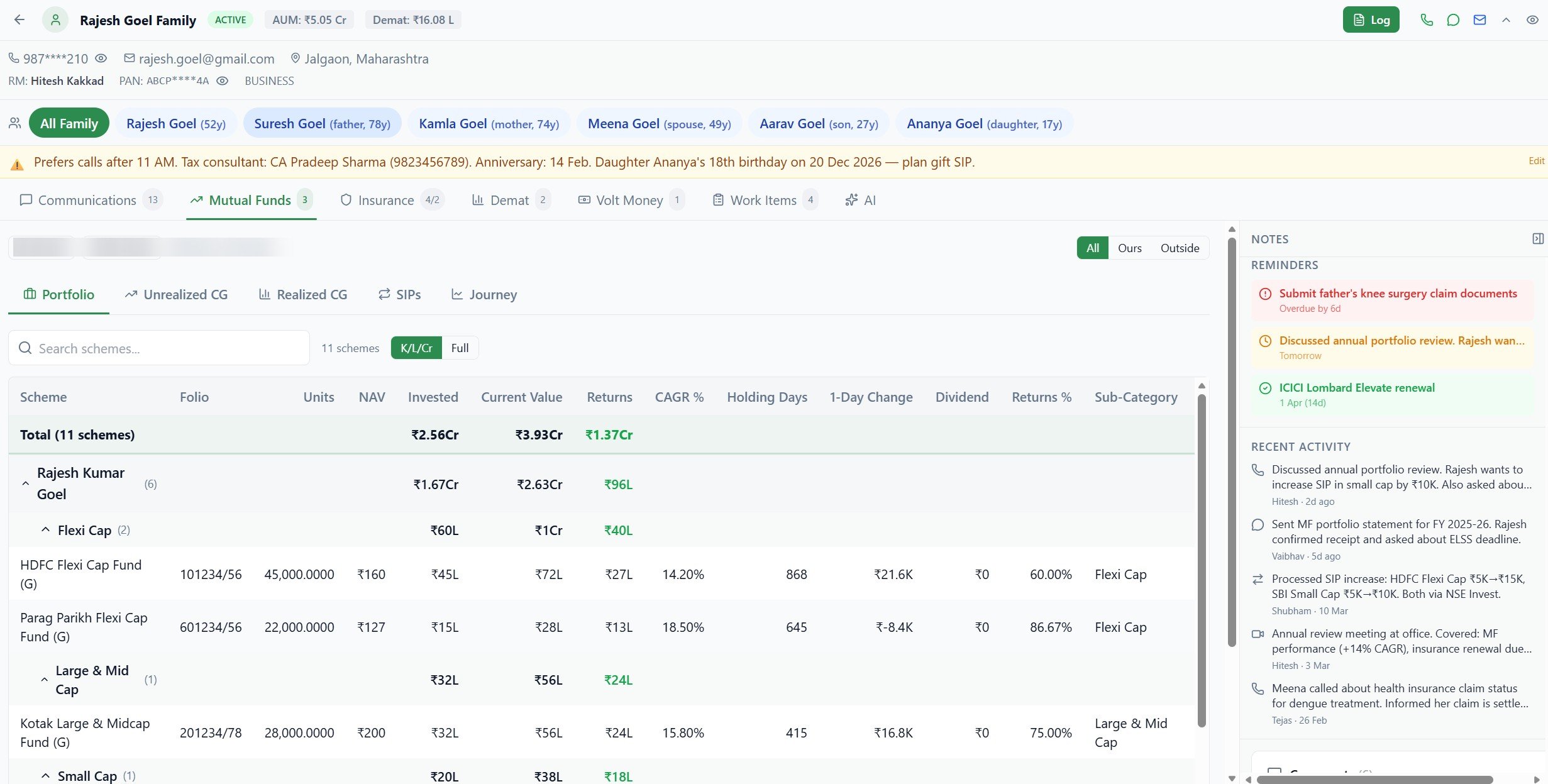
His mutual fund portfolio. His insurance policies and claim history. His demat holdings. His loan-against-mutual-funds status. Every WhatsApp conversation we’ve had. Every email. Every phone call logged. Every document we’ve ever exchanged. Every interaction, every communication, every product — on a single screen.
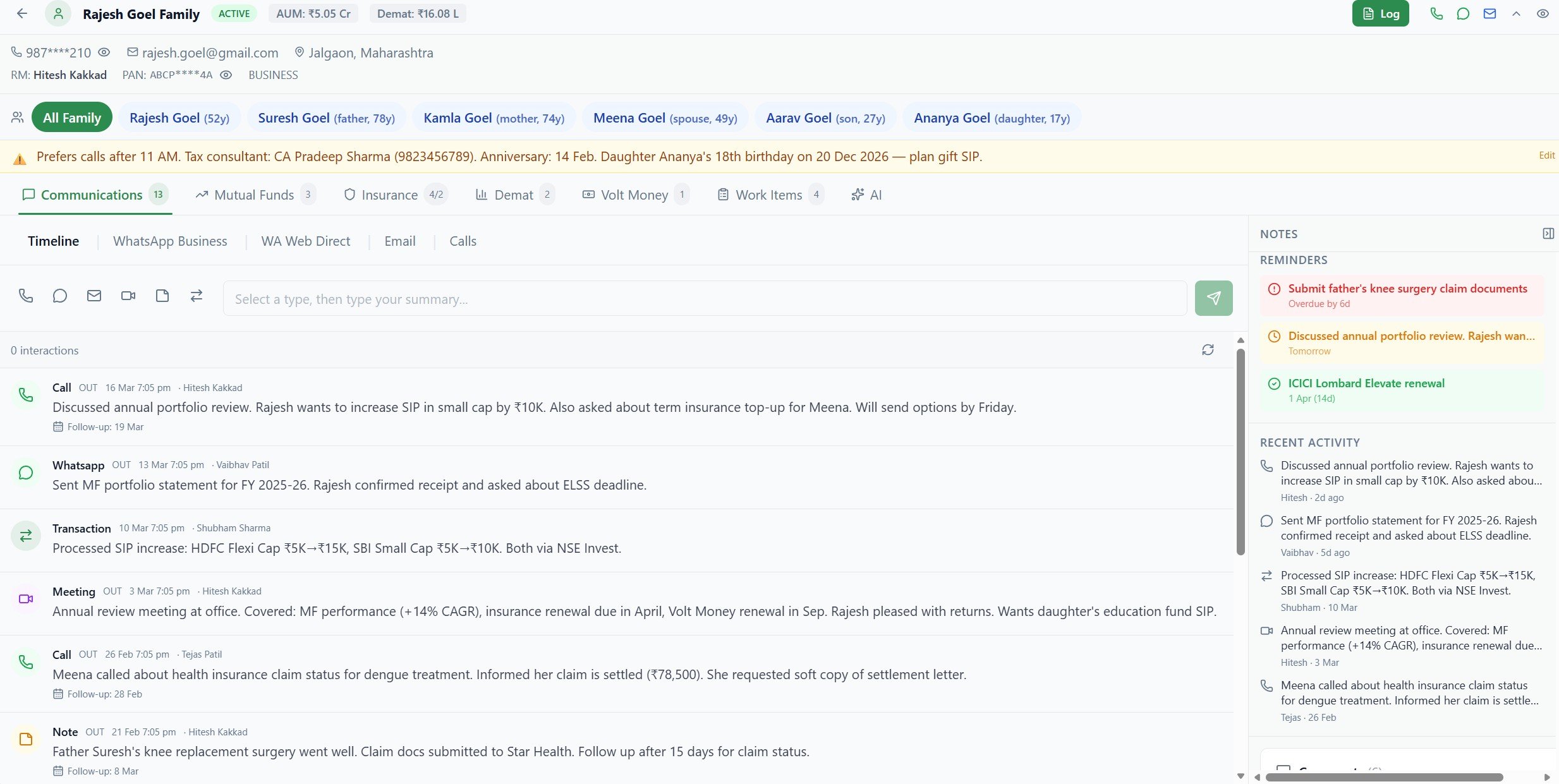
I built the Client Workspace in a single day. It gives a 360-degree view of a client that, at our scale — a retail-focused distribution firm operating from Jalgaon and Nashik — I genuinely don’t think exists anywhere else in the country. Perhaps large corporates like Prudent or NJ have built similar capabilities with dedicated tech teams and years of development. But for a home-grown, bootstrapped firm like ours? This is uncharted territory.
And that’s not arrogance. That’s twenty years of knowing exactly what was missing, compressed into code.
Chapter 12: The Great Consolidation
Before Aventryx, our daily operations ran on eight to nine different software platforms. Each one handled a slice of our business — insurance management, WhatsApp automation, client CRM, web integrations, AI tools, and the ever-present Excel sheets filling every gap in between.
Today? One system. One login. One source of truth.
Almost every standalone tool we were using has been replaced by a module inside Aventryx — purpose-built for our exact workflows, our exact team structure, our exact client base. The only external platform that stays is InvestWell for mutual fund portfolio management — and even that is deeply integrated, not siloed.
That’s not eight platforms awkwardly stitched together. That’s eight platforms dissolved into one that was designed, from day one, to be whole.
Cost saving is an obvious advantage. But the real wins are elsewhere: productivity, accuracy, and privacy. Every piece of data lives on our own servers. No third-party AI sees our clients’ unmasked information. No data leaves our ecosystem without our explicit consent.
In financial services, privacy isn’t a feature. It’s a responsibility. And now, it’s under our roof.
Chapter 13: The Hardest Part
People ask me — what was the hardest module to build?
Honestly? None of them felt impossibly hard, because I had spent so much time giving context. When you’ve lived a problem for twenty years, explaining it to an AI assistant is surprisingly natural. The more depth I gave, the better the output. It wasn’t magic. It was preparation meeting opportunity — like a cricketer who’s been visualizing a shot for years and then the ball arrives in exactly the right slot.
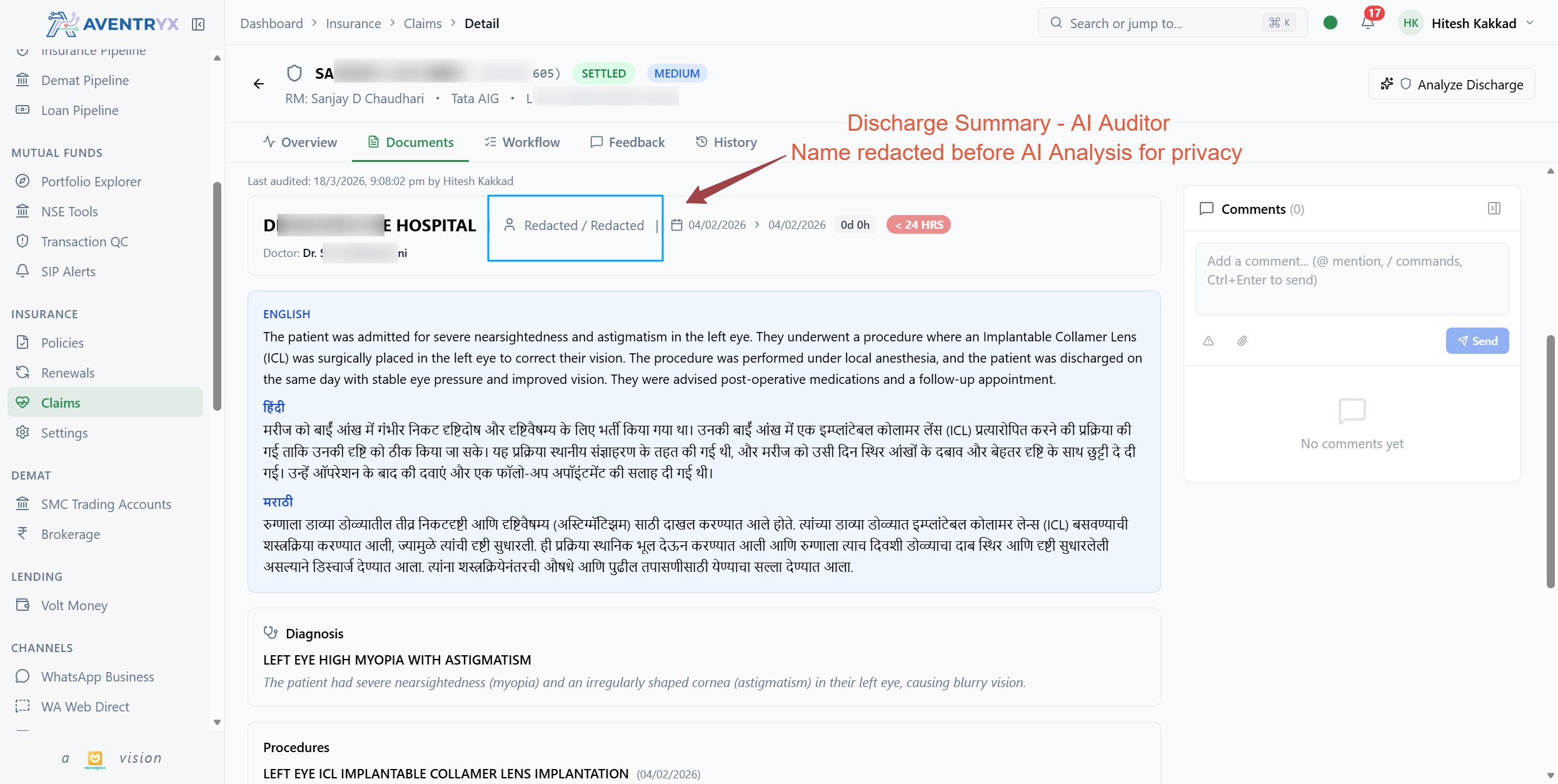
If I had to pick one, I’d say the AI module. We built a multi-pass, multi-model processing pipeline that optimizes for token usage while keeping data private. When a client uploads a hospital discharge summary for an insurance claim, the system masks all personal information before sending it to the AI for analysis. The AI never sees the real name, the real policy number, the real diagnosis linked to a real person. It gets the data it needs to do its job, and nothing more.
That kind of privacy-first AI architecture took serious thought. But it was non-negotiable. Our clients trust us with their most sensitive financial and medical information. That trust is not a feature request. It’s the foundation.
Chapter 14: What This Is Not
Let me be very clear about something, because I’ve been getting this question a lot.
Aventryx is not for sale. It is not a SaaS product. It is not for fellow distributors.
This was built for Moneyplus. By Moneyplus. For our team and our clients. Full stop.
To my friends in tech — the CRM builders, the SaaS founders, the people who build tools for our industry — I want you to know: I am not your competitor. I have nothing but respect for what you do. Building software for thousands of users with different needs is infinitely harder than building for one firm that knows exactly what it wants. You solve for the many. I solved for one. Those are fundamentally different problems.
In fact, I’m happy to share ideas. If something I’ve implemented in Aventryx could make your platform better for the broader community — reach out. I’ll walk you through it. The industry deserves better tools, and that’s a mission bigger than any one company.
Before launching, I personally called every vendor we’ve worked with. I showed them what we’ve built. I explained why we’re moving. There is no rivalry here. Only gratitude for the years they supported us — and honesty about why we needed to go further.
Chapter 15: What’s Coming for You
If you’re a Moneyplus client, this chapter is especially for you. Read it carefully.
Everything I’ve described so far — the Client Workspace, the 360-degree view, the real-time data across every product — is currently being used by our team to serve you better. But here’s what I’ve been thinking about since the day the Workspace went live:
Why should only my team see this? Why can’t you?
That’s not a five-year dream. That’s what we’re building towards — and the foundation is already in place.
I can’t promise a date yet. But I can promise this: the experience we’re designing for you is unlike anything available from any financial distributor in India today. Not because we’re the biggest. But because we built the rails ourselves — and those rails can go exactly where we want them to.
When it’s ready, you’ll be the first to know.
Chapter 16: Gudi Padwa
Today is Gudi Padwa — the Maharashtrian New Year. A day of new beginnings. And it felt like the only right day to launch Aventryx.
I won’t pretend this is a finished story. We’re launching today, and we have zero days of real-world usage. There will be bugs. There will be errors. There will be mornings where Shubham in backoffice will message me saying something isn’t working and I’ll spill my chai reaching for the laptop.
But I’ve built something I’m confident in — not because the code is perfect, but because the foundation is solid. Twenty years of domain knowledge baked into every database table, every API route, every workflow. And meticulous documentation — detailed enough that the system can be maintained and updated, even in my absence.
This isn’t a product born in a weekend hackathon. It’s a product born from two decades of doing business, making mistakes, trying tools, discarding tools, and knowing — with absolute clarity — what works and what doesn’t.
The Line I Keep Coming Back To
A fellow distributor recently asked me what Aventryx feels like.
I didn’t talk about the 186 database models or the 436 API routes. I didn’t show him the architecture diagram or explain what a multi-pass AI pipeline does. I just said one line:
But it couldn’t have come 10 years earlier. Because 10 years ago, I didn’t have the context. I didn’t have twenty years of broken workflows. I didn’t have the scars from every failed software experiment. I didn’t have the vocabulary to explain what I needed — not to a developer, not to a vendor, and certainly not to an AI.
Aventryx isn’t a product of thirty days. It’s a product of twenty years. The thirty days is just when the dam finally broke.
Curious? Go deeper.
See what 20 years of frustration looks like
when it finally becomes code.
Explore Aventryx — the features, the numbers, the story.
This Is Moneyplus. Reimagined.
We started in 2006 with Excel sheets and a dream. Today — Gudi Padwa 2026 — we launch on a system built from the ground up. By us. For us. For you. If you’re a Moneyplus client, you’ll experience the difference soon. If you’re a fellow distributor, I hope this story inspires you to build your own edge.
Huge congratulations Hitesh Bhai & team Money pkus on creating such an incredible CRM and financial services portal! 🎉
It’s truly impressive to see how you’ve combined functionality with a user-friendly experience. The platform is not only efficient but also thoughtfully designed to simplify complex business and financial processes. Your vision, dedication, and attention to detail really stand out.
This is a big achievement and a strong step toward transforming how businesses manage their operations digitally. Wishing you continued success and growth—this is just the beginning of something great! 🚀
Great journey…….and going on………
Awesome👌🏻👌🏻
Awesome👌🏻👌🏻
Really enjoyed going through the vision behind Aventryx—it’s rare to see such a thoughtful blend of clarity and ambition. The way you’ve articulated the problem and backed it with a structured, scalable approach stands out. It reminds me of how strong ideas evolve into platforms when execution meets conviction.
Loved the depth across your blogs—especially the focus on long-term thinking rather than short-term noise. Feels like you’re not just building a company, but a category.
Excited to see where this goes—always rooting for you. Let’s catch up soon and explore how I can contribute!
This is Hitesh’s Bamboo tree moment. Everyone sees your success, but few know the kind of repetitive hard work that you have put behind it. Amongst all your articles, this story is the best, and I have shared it with many because it truly deserves to be shared.